Keep toys in the living room without taking over the seating
Keep a manageable selection of toys near family seating and give the rest a different home.
Define the part of the room that is shared
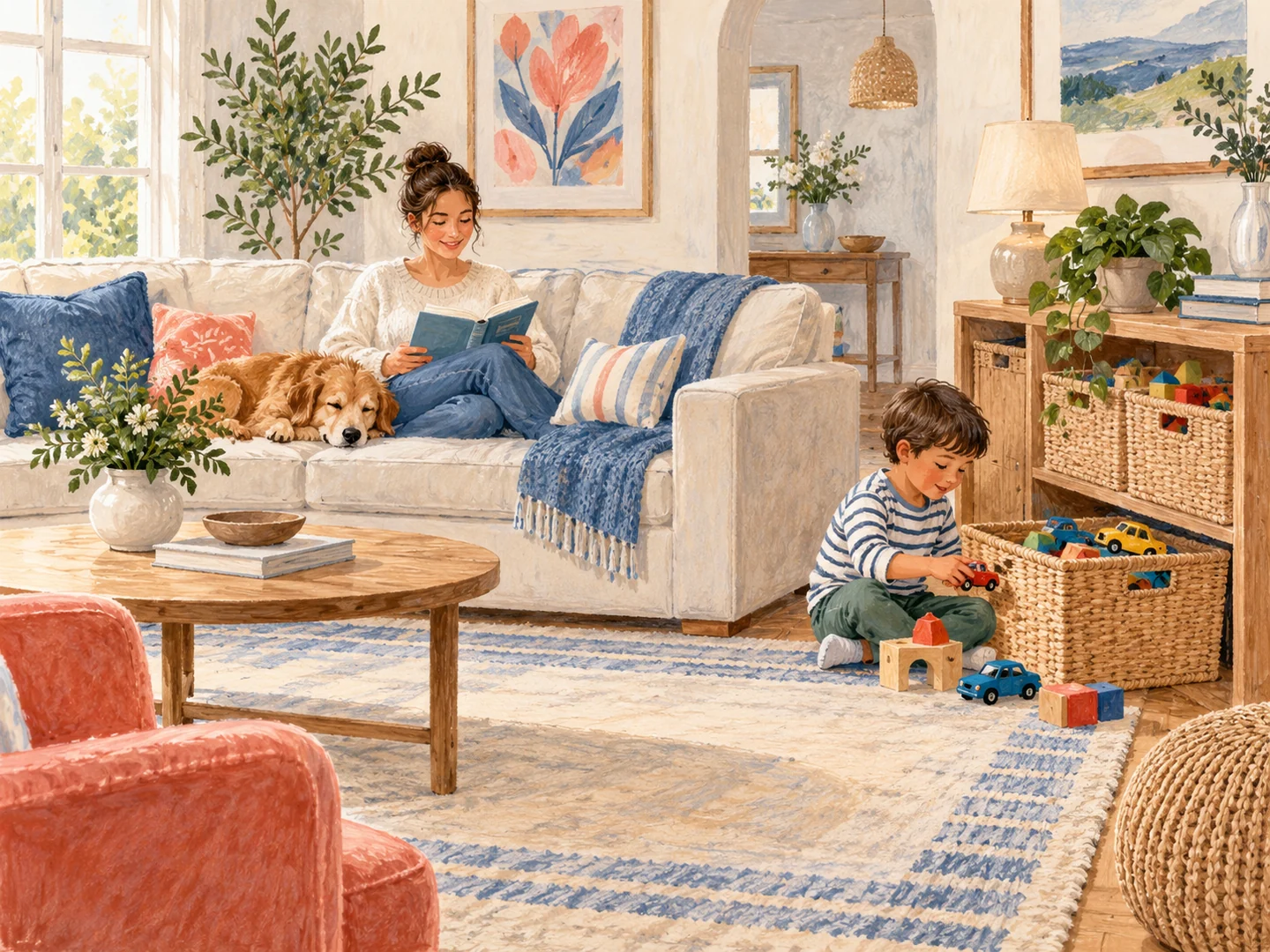
A living room can welcome play without every seat becoming a toy shelf. Start by protecting the activities the room must support: sitting together, walking through, reading and perhaps watching television. Identify a small play area that does not block those uses. The boundary may be a rug edge or one low storage unit rather than a separate playroom.
Bring in only the toys that make sense there. A few building materials, picture books and a current favorite can be easier to use than a large mixed collection. Toys with many tiny parts may belong in a supervised activity space, especially when younger children share the room. Follow age guidance and keep hazardous pieces out of reach.
Choose storage by the way toys return
Open containers can make cleanup simpler for bulky toys, while a small divided box may suit a set whose pieces need to stay together. Avoid a deep container that requires dumping everything to find one item. Check any toy chest for appropriate safety features; a heavy free-falling lid creates a different problem from clutter.
Measure the available space with the sofa and chairs in their usual positions. A basket should slide out without moving a coffee table every time. A cabinet door needs room to open. Secure furniture as its instructions require, and keep heavy objects low without encouraging climbing to reach an attractive toy displayed above.
Plan for the moment more than one child wants to play. A single large bin can become a bottleneck if both need to search it at once. Two modest containers with distinct contents may work better without increasing the total number of toys. Watch a normal play session before deciding whether the room needs more storage or simply a different distribution.
The containers need not all match, but a restrained mix can help the room feel settled. A fabric bin may sit beside the sofa, with a shelf for books and a separate lidded container accessible only to an adult for small-piece activities. The storage type follows the toy, not a photograph of an empty room.
Rotate because interest changes
Move out toys that are no longer being used before buying more living-room storage. A rotation can be informal: when a new set comes in, another complete set returns to its main storage place. Keep pieces together so the next return is inviting rather than a search for missing parts.
Leave a little unused capacity. A container packed to the rim requires careful arrangement from the adult who knows the system, whereas a partly filled bin allows a child to help without stacking perfectly. The useful test is whether the ordinary cleanup fits into the household's actual energy at the end of the day.
Allow some play to remain in progress when the room can accommodate it. A construction on a small tray may move aside without being dismantled. But keep seating and routes available, and agree on a specific place for ongoing work. A project spread over every cushion is difficult for the rest of the family to live around.
If toys repeatedly spread beyond the boundary, check the quantity and the activity before adding rules. The room may be carrying too many categories, or the chosen container may be awkward. Reducing the number of things nearby can make play more visible as well as cleanup easier.