Make basket labels that can change with the contents
Use replaceable cards and simple holders so a basket can change jobs without carrying an outdated label.
Name the contents people look for
The best basket label answers a real question. "Library books" is more useful than "Reading," and "Clean washcloths" is clearer than "Bath." Before making labels, use the baskets for a few days and notice what actually lands in them. A category invented to fill a shelf may be too broad to help anyone put things away.
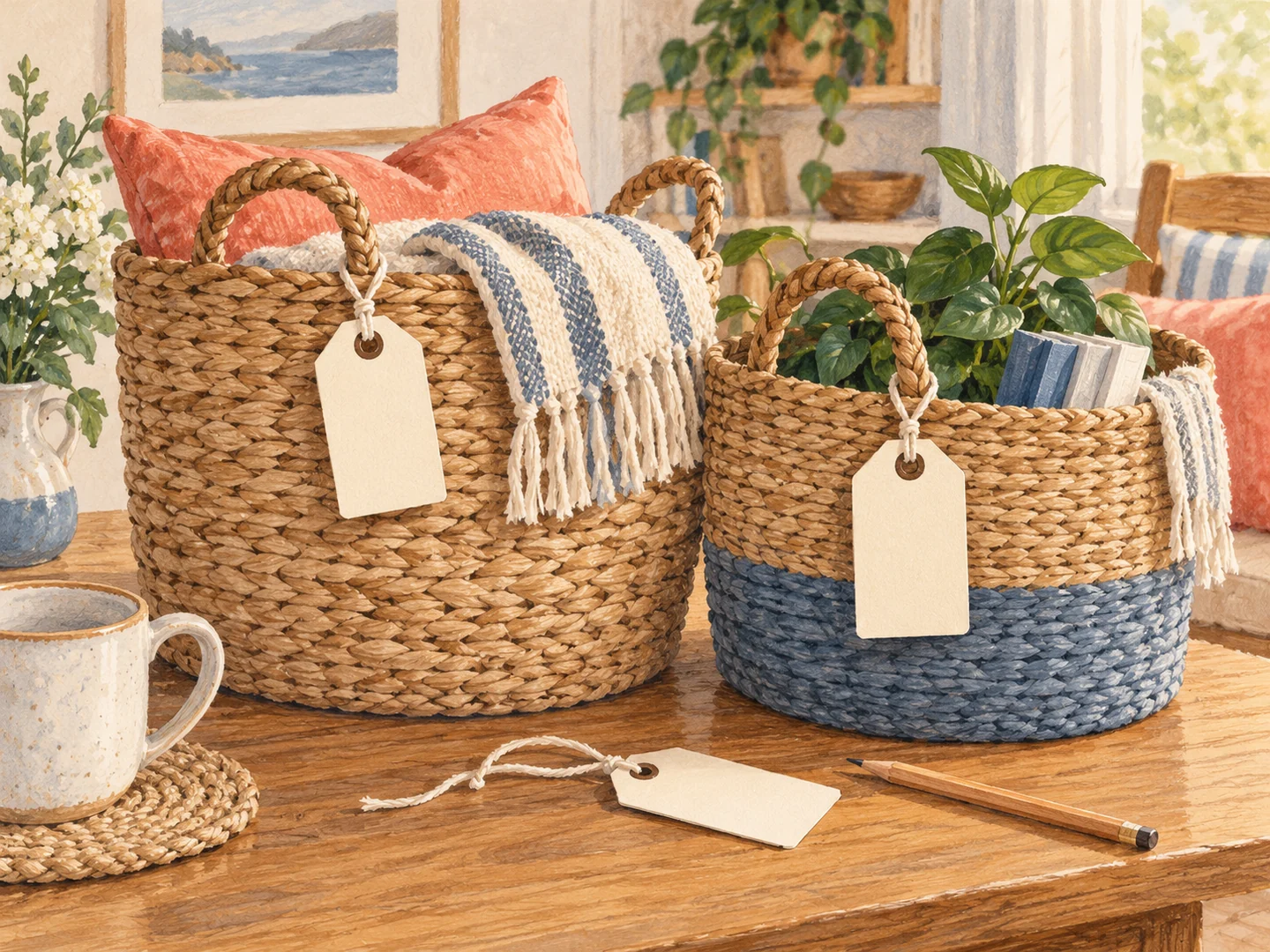
Keep the wording short enough to read at the basket's normal height. A low basket needs a label visible from above or on its upper front edge; a basket on a high shelf needs a front-facing label. Test a handwritten paper slip first. If it cannot be read from the usual approach, a beautiful smaller version will not solve the problem.
Make the wording replaceable
A sleeve or clip designed for the basket allows the card to change while the attachment stays put. Check that the holder will not snag clothing, scratch a shelf or detach easily where young children can reach it. Avoid loose beads, long ties and small decorative parts on children's storage. In some rooms, a large card slipped behind an open weave is all that is needed.
Cut several cards from the same sheet of firm paper and keep a few blanks. Use dark lettering on a light background, or the reverse, with enough contrast to work in the room's lighting. A small symbol can support a word for a child who is learning to read, but it should be something recognizable rather than an abstract decorative icon.
If two baskets have similar contents, make the distinction specific. Separating 'Spare cables' from 'Chargers in use' gives each a different job, while 'Tech' on both adds little. Test the wording with another household member before printing or lettering a full set. If they would put the same object in either basket, the category boundary needs attention more than the lettering does.
Fit one label before making a whole set. Pull the basket out and return it to its shelf. If the label catches on the shelf above, move it lower or choose a flatter holder. Where baskets sit side by side, align labels according to what can be seen rather than forcing identical placement on baskets with different shapes.
Leave some baskets unlabelled
A single basket holding throws beside a sofa may not need an explanation. Labels earn their place where several similar containers hide different things or several people share the storage. Too many words can make a living room feel like a supply cupboard without making it easier to use.
When a basket changes purpose, replace the card immediately and remove the old one instead of stacking new labels over it. Keep the spare blanks near household stationery. The system stays flexible because changing "Winter hats" to "Swim things" takes one minute, not another craft session.
If the contents repeatedly fail to match the label, reconsider the category. A basket close to the door may naturally collect sunglasses and keys rather than the mail you planned for it. Relabeling an appropriate location is often easier than persuading everyone to walk past it.